
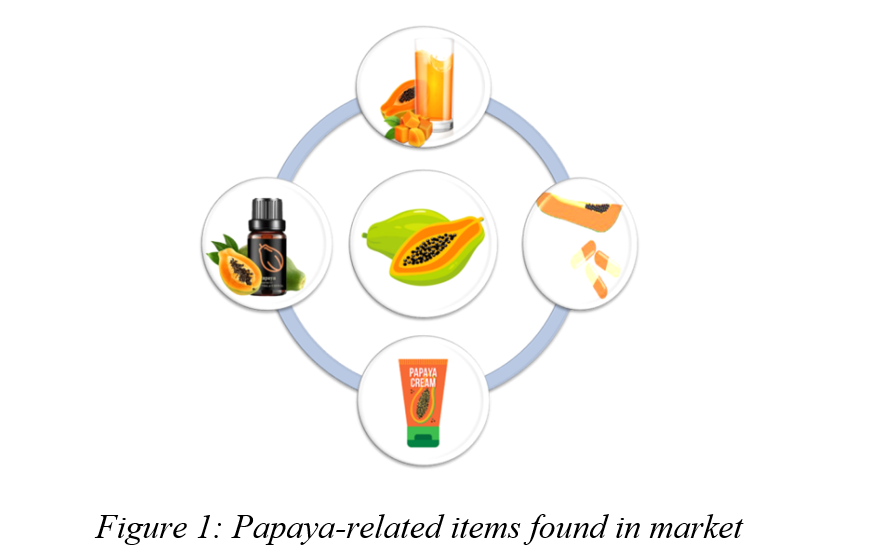
The valorization of papaya refers to the process of maximizing the economic and environmental benefits derived from papaya production while minimizing waste and resource inefficiency. It involves finding innovative ways to utilize different parts of the papaya plant, including the fruit, seeds, and peels, for various purposes beyond traditional consumption. They are available in the market in several forms and products (Figure 1).
Papaya (Carica papaya) is extensively cultivated across numerous tropical regions worldwide and is widely acknowledged for its nutritional richness and numerous health advantages. It is frequently employed in the production of processed goods and the extraction of valuable enzymes like papain. Remarkably, a significant portion of the papaya, namely the seeds and peels, typically constitutes up to 20% of the total fruit weight and is often discarded during processing. Consequently, there has been a growing interest in the reclamation of valuable chemical components from papaya biowastes with the aim of generating value-added products. The papaya seeds are particularly noteworthy for their nutrient composition, with a significant content of glucosinolates contributing to their health-enhancing properties. Additionally, these seeds serve as a rich source of lipids, proteins, and dietary fibers. Likewise, the peels contain an abundance of fibers and carotenoids.
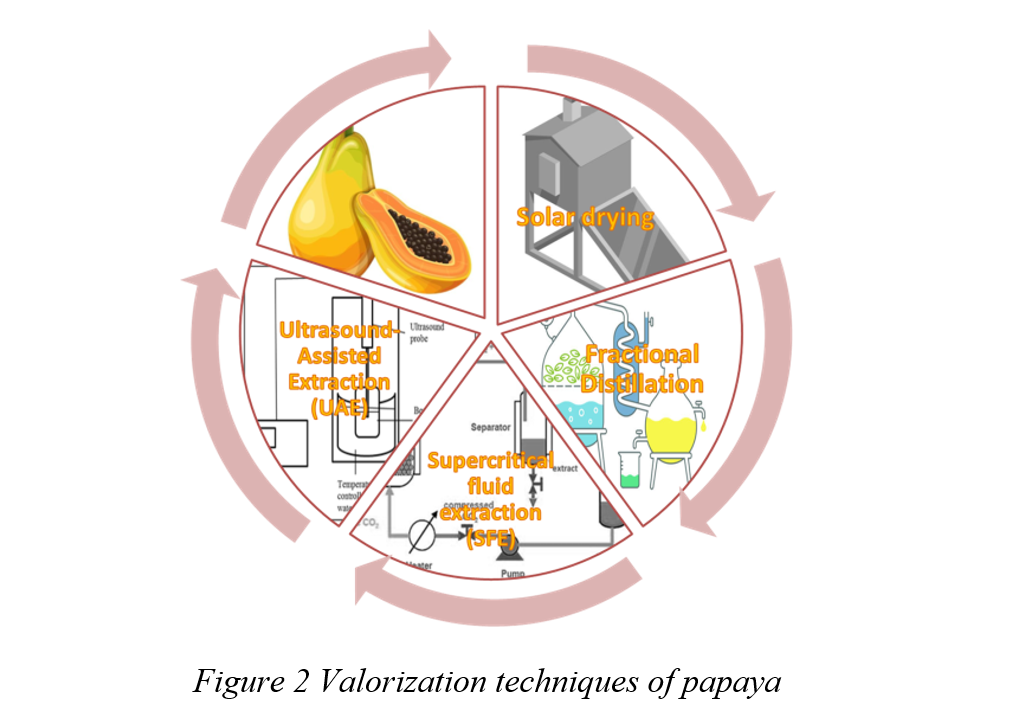
The global production of papaya (Carica papaya) surpassed 12.6 million metric tons in 2014, as reported by the Food and Agriculture Organization of the United Nations. Given the substantial quantity of papaya produced and an estimated cull rate ranging from 30% to 50%, there is a considerable volume of agricultural waste generated. Therefore, the implementation of valorization practices for papaya fruit biowastes is not only essential to mitigate waste but also offers the opportunity to create value-added products. Various valorization techniques(Figure 2) for maximizing the utilization of the non-edible portions of papaya are discussed below.
Utilizing Solar Drying for Papaya Fruit Enhancement
Effective solar drying systems, employing innovative and gentle technology, offer a valuable approach toenhancing the utility of papaya fruit. These solar dryers are capable of conducting drying experiments on both papaya flesh and papaya seeds, leading to the creation of fruit-based ingredients with extended shelf life. The resulting products exhibit microbiological safety, boasting values below 0.55, along with sustained stability over a minimum period of two months and desirable calorimetric attributes. These dried products can be harnessed for the development of functional foods geared towards enhancing the nutritional and health status of school-age children. The inclusion of fruit meals is primarily for their high fiber content and abundant phytochemicals, while papaya seeds are incorporated for their anthelmintic properties.
Utilizing Supercritical Fluid Extraction (SFE) to Reclaim Phenolic Antioxidants from Agricultural Waste (Papaya Seeds)
Supercritical fluid extraction (SFE) stands out as an environmentally friendly technology suitable for the retrieval of phenolic antioxidants from discarded papaya agro-industrial waste, particularly papaya seeds. This process harnesses pure supercritical CO2 or CO2 augmented with ethanol (CO2-EtOH) for phenolic recovery. Optimal conditions for this phenolic recovery involve maintaining temperatures within the range of 40 to 60 °C and pressures between 10 and 30 MPa to achieve desirable yields and high total phenol content (TPC). Additionally, ethanol is introduced as a co-solvent during the process. The assessment of antioxidant activity is carried out using HPLC-ESI-MS.Utilizing Ultrasound-Assisted Extraction (UAE) for Papaya Seed Oil Recovery
The application of ultrasound-assisted extraction proves to be a suitable method for the retrieval of oil from papaya seeds. This technique yields papaya seed oil with a desirable fatty acid profile, all within relatively brief extraction durations and under moderate conditions when compared to various solvent-based extraction methods. The primary aim of ultrasound-assisted extraction (UAE) is to enhance the oil recovery from papaya seeds in contrast to conventional extraction techniques such as Soxhlet extraction (SXE) and solvent extraction (SE). The UAE approach achieves higher oil recovery yields and offers a favorable fatty acid composition and triacylglycerol profile for papaya seed oil when compared to alternative extraction methods. An analysis of the fatty acid composition reveals that the predominant fatty acids in papaya seed oil are oleic (18:1, 70.5%–74.7%), palmitic (16:0, 14.9%–17.9%), stearic (18:0, 4.50%–5.25%), and linoleic acid (18:2, 3.63%–4.6%). Furthermore, the most prevalent triacylglycerols in papaya seed oil include triolein (OOO), palmitoyl diolein (POO), and stearoyl oleoyl linolein (SOL).Fractionation of Papaya Juice and Seed Lipids
The process of fractionating papaya is a simple method that can be easily implemented, even in areas with limited resources. Extracting seed oil from discarded papaya material presents a promising alternative carbon source for yeast, such as Yarrowia lipolytica, and opens up new avenues for sustainable production of various high-value bio-based chemicals. This process enables the efficient production of seed oil derived from papaya waste, which is essentially free from the antimicrobial compound BITC. This oil, without the need for additional refinement, has proven to be a suitable carbon substrate for the industrially significant yeast, Y. lipolytica. It supports robust growth, with a maximum specific growth rate of approximately 0.31 per hour, an apparent biomass yield coefficient of 0.367 g dry cell mass per g of oil, and substantial production of recombinant nanobodies, reaching 67 mg L−1 in culture. Importantly, by utilizing both papaya juice and seed lipids instead of just juice, as traditionally done, the yield of Y. lipolytica biomass per unit of papaya more than doubled.(Content shared by Linthoingambi Ningombam, Department of Fruit Science and Dr. Yengkhom Disco Singh, Department of Post- Harvest Technology, College of Horticulture and Forestry, Central Agricultural University, Pasighat, Arunachal Pradesh)